28 Cheshvan, 5784 / 12 November, 2023
In the first chapters of The Church Beyond the Congregation ( CBC) James Thwaites established that the enemy sowed a type of mind construct or way of thinking in the ancient world which dislodged the created spiritual realm of the heavens of God into another removed realm. The early church soon became infected with this “virus” of Platonic thinking (ironically in the context of fighting off heretical, false teachings):
The Neoplatonic spiritual realm, standing in opposition to the real world and available only through the church, increasingly became the status quo. It was this brand of Christianity that spread across Europe, extinguished the lamp of Celtic Christianity in Ireland and Britain and found its way into the Holy Roman Empire.
(p15)
Thomas Aquinas and the Medieval Church
This is of course a 50 000 metre bird’s eye view looking down on the flowing river of history in the west. Of course there are vast tributaries and rivers of influence and formation through the last two thousand years of western history which would need close examination. Could it be though that this faulty operating system almost silently and imperceptibly was passed on from one century to the next? First in church structures and practices and then born into the cultural children given birth out of it?
The Catholic theologian Thomas Aquinas (1225-1274) was a heavyweight of Roman Catholic Doctrine. Thwaites argues that Aquinas reinforced the split universe. First, he followed the Greek philosopher Aristotle in saying that human reason and observation would enable us to understand the world around us. This he called natural theology. So good so far. This was about using our God given abilities and intelligence to make sense of the creation realities all around us. However, the Platonic virus was at work and the wall reinforced. Behind metaphysical barbed wire and a towering wall Aquinas defined revealed theology. This was the realm of the Bible, church traditions and the gateway to the removed spiritual realm. Guarding over this exclusive gateway with the Latin mass inscribed above the gateway were the priestly philosopher-kings.
The Renaissance movement seeds had been sowed leading to a flowering and blooming of art and literature in the 14th Century:
The reason for this renaissance was that the two-step process freed humanity to use its reason to discover the world, independent of the church. The church was preoccupied with the ‘upper storey’ that was taken care of by the priest, the mass and the sacraments. The ‘bottom storey’, with artisans and intellectuals now empowered by reason, broke free of the church and, along with much of the populace never really came back. (p17)
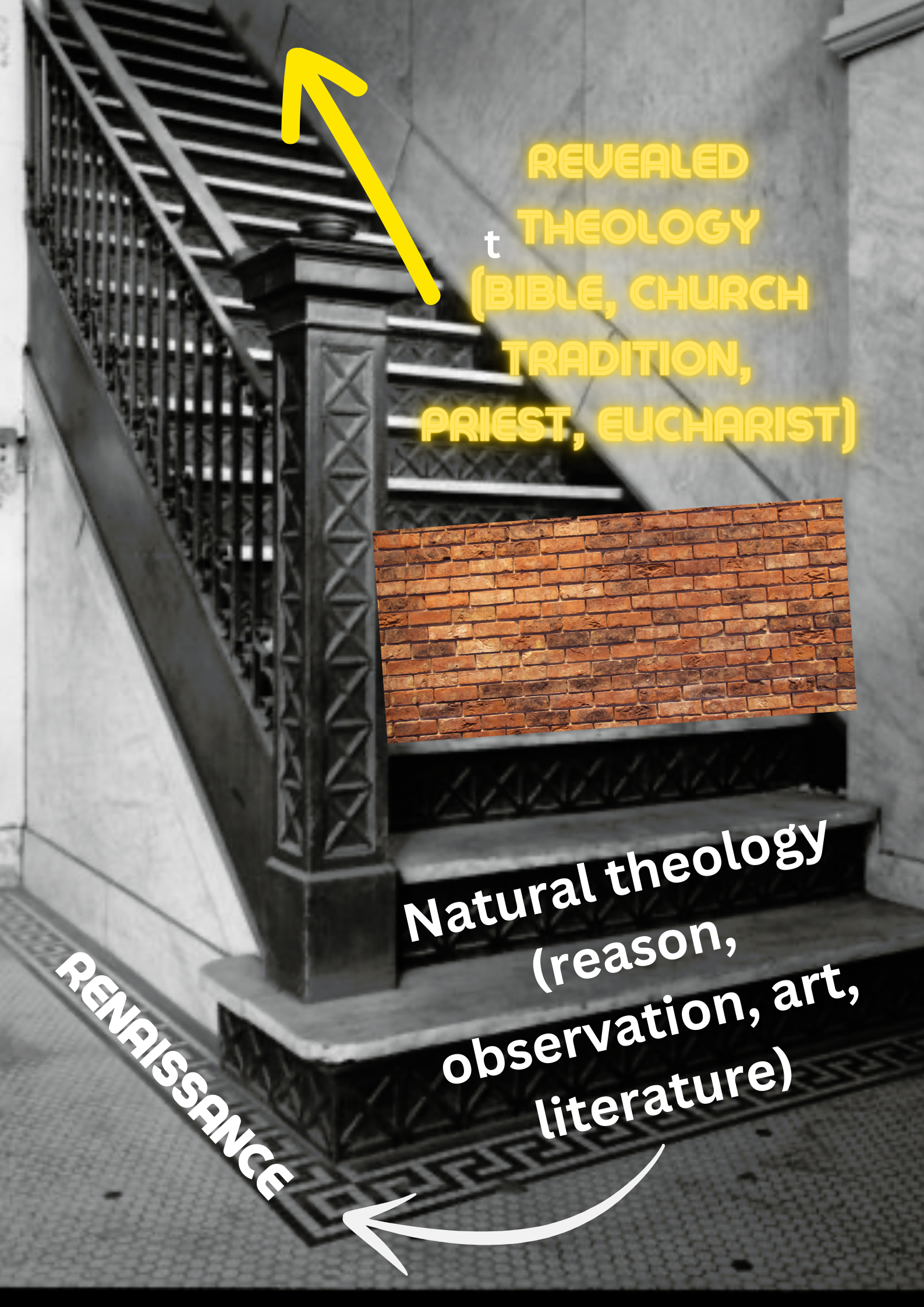
staircase photo: Wikimedia commons
© Stephen Paul Jacob

 Image Bearers
Leave a comment